If your sales team can't see it where they already work, it isn't real. The architecture problem killing most partner programs.
What is CRM-First Ecosystem Governance?
The operational standard where every partnership activity—sourced, co-sold, or influenced—is a verifiable record in the CRM. If it isn't in the System of Record, it doesn't exist for Sales, it doesn't exist for Finance, and it doesn't exist for your career growth.
Part of the BlueThread GTM Framework
We spend too much time in spreadsheets and not enough time co-selling with AEs.
Moving all partner activity into native HubSpot/Salesforce objects to gain internal trust.
Elimination of 'He-said/She-said' attribution and 100% visibility for your VP of Sales.
TL;DR
- Partner data outside your CRM is invisible to revenue teams.
- Integrate partner activity into your CRM for revenue impact.
- Treat partnerships with the same rigor as direct sales.
If you only do one thing: Ensure partner data resides within your CRM.
🎯Key Takeaways
- 1Partner activity not in the CRM is effectively non-existent for revenue.
- 2Separate partner portals create a "parallel universe" disconnected from deal-making.
- 3Economic shifts demand measurable ROI, making CRM integration crucial.
- 4Account mapping insights must flow directly into the CRM for AE use.
- 5Sellers need immediate contact information and context to act on partner overlap.
- 6If your sales team can't see it where they already work, it isn't real.**
- 7There is a pattern we see in almost every partner org we talk to.
- 8The partnership team is busy. There are QBRs with partners, co-marketing campaigns in flight, a PRM with hundreds of registered deals, and a Slack channel full of activity. The Head of Partnerships can pull a deck showing impressive numbers.
- 9But when the CRO opens Salesforce, none of it is there.
- 10No partner influence on pipeline. No visibility into which accounts already have partner overlap. No record of the co-sell activities that moved a deal from stalled to closed.
- 11To the revenue team, the partnership program does not exist.
- 12This is not a data problem. It is an architecture problem. And it is the single most common reason partner programs fail to prove their impact; not because partnerships do not work, but because they were never built inside the systems where revenue actually lives.
The Parallel Universe Problem
For years, partner teams built their own infrastructure.
Separate portals. Separate dashboards. Separate workflows. It made sense at the time. PRMs were designed to give partners a home. The problem is that home was never connected to the house where deals get done.
The result is a partner program that runs alongside the revenue engine instead of inside it.
Sales reps do not check the PRM. They check Salesforce. Finance does not trust partner attribution reports from a separate system. They trust what is in the CRM. Executives do not approve headcount based on data they cannot verify. They approve it based on numbers they can tie to closed revenue.
If partner data is not inside the systems that sales, finance, and leadership already use, it does not count. It does not influence decisions. It does not justify investment.
It simply does not exist.
Why Integration Is Not Optional Anymore
The economic environment has changed. In the era of cheap capital, partner teams could survive on relationship metrics, logos, and activity volume. Boards tolerated soft ROI because growth at all costs was the mandate.
That era is over.
Today, the CFO wants to know exactly which partner activities contributed to revenue, at what stage, and with what measurable impact. The CRO wants to know which accounts have partner overlap before the AE makes the first call. RevOps wants partner data to flow through the same pipeline model as every other channel.
This is not a higher bar. It is the same bar every other revenue function is held to. Partnerships has simply been exempt from it for too long.
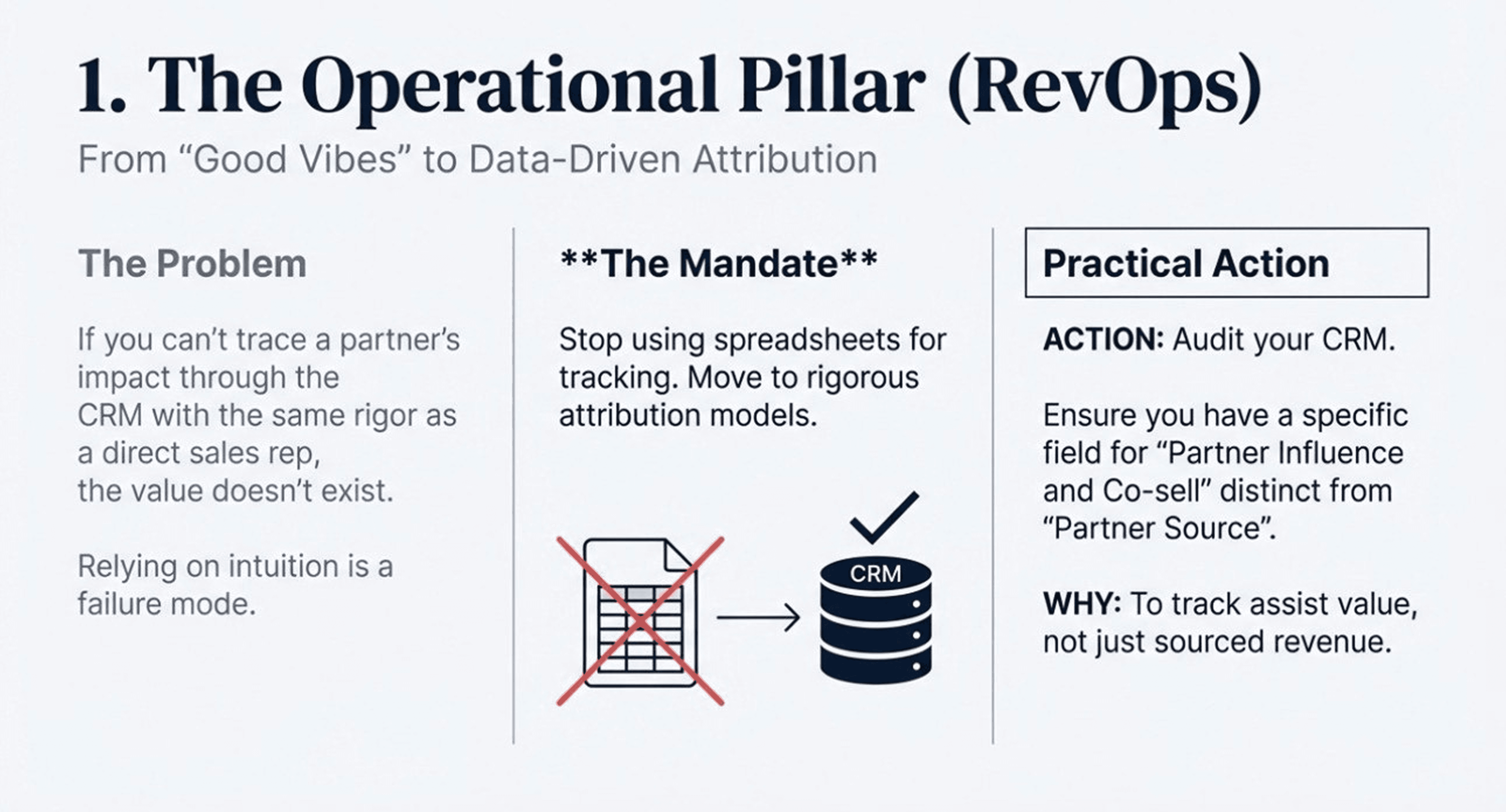
The modern mandate is total integration. Partnerships must be tracked with the same rigor as direct sales. That means the data has to live where revenue lives; inside the CRM.
The Four Systems That Close the Gap
Operationalizing partner data inside the revenue engine is not a single tool decision. It is an architectural one. There are four distinct systems that have to work together.
System of Record: Can you see where partners overlap with your accounts?
Account mapping is the starting point. Tools like Crossbeam exist to surface this overlap, but the data cannot live inside Crossbeam alone. The insight has to flow into Salesforce or HubSpot so that AEs see partner intelligence directly on the account record, where they already work.
If an AE has to log into a separate platform to check for partner overlap, they will not do it. The overlap has to be visible without changing the workflow. If it is not in the CRM, it is invisible.
System of Action: Can sellers act on the overlap immediately?
Surfacing overlap is not enough. The AE also needs to know who to contact. Enrichment closes that gap. When account mapping shows that a strategic partner has three shared accounts in a specific segment, the AE needs contacts, context, and a reason to reach out; all without leaving their existing tools.
Insight without activation is noise.
System of Velocity: What happens when a partner sends a lead?
This is where most programs break down operationally. A partner registers a deal or sends a referral. It lands in a shared inbox. Someone on the partner team reviews it. Eventually it gets routed to an AE (maybe a day later, maybe a week later) with no SLA and no ownership clarity.
By the time the AE touches it, the momentum is gone.
Routing, attribution rules, and response time SLAs are not optional. They determine whether partner-sourced pipeline becomes revenue or frustration. Every lead that comes through a partner needs an owner, a timestamp, and a defined next action within hours, not days.
System of Cloud GTM: Are you aligned to cloud marketplaces from the start?
If AWS, Azure, or GCP is part of your go-to-market motion, that alignment has to be engineered into the workflow from day one. Marketplace is not a procurement shortcut you add at the end of a deal cycle. It is a designed path that affects how you register opportunities, how you engage hyperscaler field teams, and how you structure the financial transaction.
Teams that try to bring Marketplace in at the close lose time, lose the hyperscaler's attention, and often lose the deal advantage entirely.
The Architecture Shift Most Teams Miss
Technology is necessary. It is not sufficient.
Most partner teams approach this as a tool problem. They buy a PRM, integrate Crossbeam, add LeadIQ, and assume the problem is solved. It is not. The tools only work if the underlying architecture is right.
That architecture has three layers.
First, the data model. CRM fields need to exist for partner influence, not just lead source. There needs to be a way to log co-sell activity against an opportunity, track which stage a partner entered the deal, and record what they actually did. Without the fields, the data has nowhere to land.
Second, the process. Deal routing rules, SLAs, attribution criteria, and escalation paths need to be defined and enforced before the first partner lead comes in. These are not decisions you make reactively. They are decisions you build into the system.
Third, the reporting. RevOps needs to be able to pull a report showing partner-influenced pipeline, partner-sourced close rates, and deal velocity for partner-touched opportunities versus direct-only. If that report does not exist, the architecture is incomplete.
This is the operational difference between a partner program and a partner GTM motion. A program has activities. A motion has measurable output that shows up in the same reports that finance and leadership trust.
The Litmus Test
Here is the simplest way to diagnose whether your partner program is operationalized or theoretical.
Ask your Head of Partnerships to produce three things without leaving Salesforce or HubSpot: a list of all open opportunities where a partner is actively involved, the average time from partner lead registration to first AE contact for the last quarter, and a comparison of close rates on partner-touched deals versus direct-only deals.
If those three reports do not exist, the program is not embedded in revenue. It is running parallel to it.
The goal is not to make partnerships visible to the partnership team. It is to make partnerships visible to the people who own the revenue number. Sales leadership, finance, and the executive team need to see partner impact in the same views they use every day.
When that happens, the conversation changes. Partner investment stops being defended and starts being demanded.
Where to Start
The instinct is to buy more tools. Resist it.
Before adding any new technology, audit what you already have. Most companies are underusing Salesforce or HubSpot before they need a PRM. The question is whether the CRM fields, views, and reporting structures that partner data needs actually exist.
Start there. Build the data model. Define the attribution rules. Set the routing SLAs. Get those foundations right, and the tools you already have will do more than any new platform will without them.
Strategy without systems is storytelling.
If you are trying to operationalize ecosystem revenue and the architecture feels broken, that is exactly the problem we help teams fix. Start with the systems. The proof follows.
From the Manual: This framework is the foundation of Chapter 3 in The Partnership Operator's Manual for the AI Era. Get the book on Amazon.
Subscribe to the newsletter
Get the Weekly Partnership Brief
The Partnership Brief is a weekly highlight of partnership, co-sell, and hyperscaler news, written for operators.
Rate this article
Comments
No comments yet. Be the first to share your thoughts.
Sign in to join the conversation
Sign InPart of the BlueThread Knowledge Platform
This article belongs to the Partner RevOps hub - frameworks, field notes, research, and case studies on the topic.