Most partnership teams are running a multi-million dollar motion on spreadsheets, Slack threads, and gut feel. The fix is building partner attribution directly inside HubSpot and Gong.
What is Partnership Tech Stack?
The integrated set of tools (CRM, account mapping, partner portal, attribution) required to operationalize partner-sourced revenue, moving it from relationship-driven to systems-driven.
Part of the BlueThread GTM Framework
Partner data lives in spreadsheets and Slack, never reaching the CRM
Integrate Crossbeam/Reveal for mapping, CRM for attribution, Gong for co-sell intel
Real-time partner pipeline visibility for CROs and CFOs
TL;DR
- Stop managing partnerships with spreadsheets and Slack.
- Integrate partner data directly into HubSpot and Gong.
- Leverage Gong Forecast for predictive partner pipeline insights.
If you only do one thing: Tag partner activity within HubSpot and Gong for every deal.
🎯Key Takeaways
- 1Most partnership teams rely on outdated, manual data tracking.
- 2HubSpot is crucial for tracking and attributing partner revenue.
- 3Gong provides real-time visibility into partner-influenced deals.
- 4Integrating HubSpot and Gong closes attribution and visibility gaps.
- 5Gong Forecast offers predictive insights into partner pipeline performance.
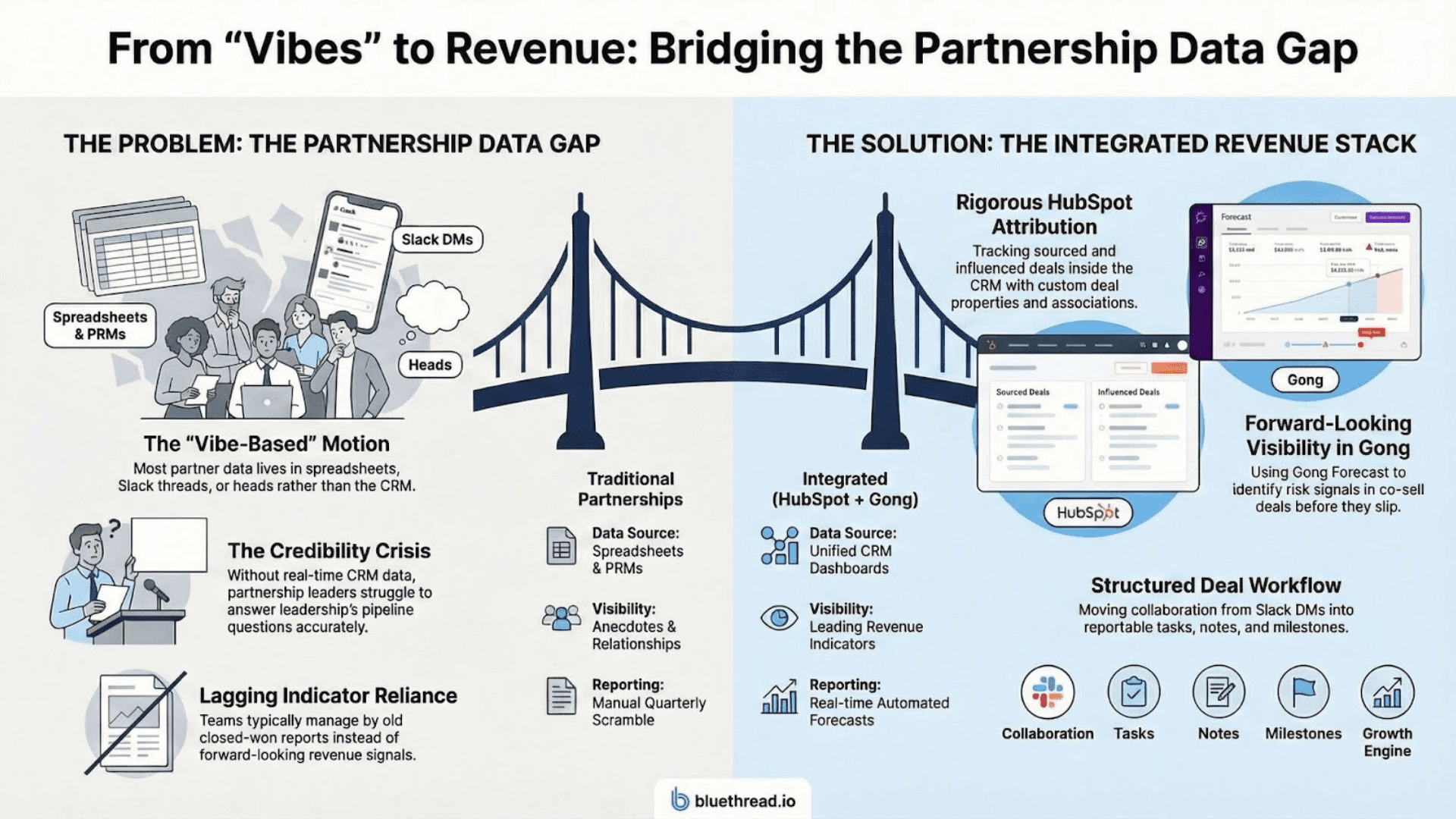
- 6Most partnership teams are running a multi-million dollar motion on spreadsheets, Slack threads, and gut feel. When the CRO asks what partner pipeline looks like this quarter, the answer is a scramble, not a dashboard. The fix is not a new PRM. It is building partner attribution and co-sell visibility directly inside the revenue systems your sales team already uses: HubSpot and Gong.
The Problem Nobody Talks About
Most partnership leaders can tell you who their top partners are. They can tell you about the co-sell deals in flight. They might even have a quarterly report that shows partner-sourced revenue.
But ask them to pull that data from their CRM, in real time, with the same rigor their sales counterpart uses for direct pipeline, and it falls apart.
The data lives in a PRM that nobody updates. Or a shared Google Sheet. Or worse, in the partner manager's head.
This is a credibility problem disguised as a data problem.
Why HubSpot and Gong, Together
HubSpot and Gong are two of the most powerful systems in a modern revenue stack. But most partnership teams barely touch either one. They are treated as sales tools, not ecosystem tools.
That is backwards.
If partnerships drive revenue, and they do, then partner activity needs to live where revenue gets managed and measured.
HubSpot is where deals get tracked, pipelines get forecasted, and attribution gets measured. If partner-sourced and partner-influenced deals are not properly tagged and structured inside HubSpot, they do not exist in the eyes of your revenue leadership.
Gong is where the truth about your deals lives. Every conversation, every signal, every risk indicator. When partner-influenced deals are properly connected to Gong, you get something partnership teams have never had before: forward-looking visibility into ecosystem revenue.
Together, they close four critical gaps:
| Gap | What It Costs You | What Good Looks Like |
|---|---|---|
| Attribution | Partner revenue exists only in a separate report | Partner-sourced, co-sell, and influenced deals tagged inside HubSpot with the same discipline as direct pipeline |
| Visibility | "Trust me, the partner is helping" | Partner activity documented, associated, and visible to anyone who touches the opportunity |
| Workflow | Deal collaboration in Slack DMs | Activity logged as notes, tasks, and calls tied to specific deals and sales cycle milestones |
| Intelligence | Lagging closed-won reports | Leading indicators showing which partners are driving predictable pipeline |
The Gong Forecast Angle Nobody Is Talking About
Most partnership leaders still manage by lagging indicators. Closed-won reports. Quarterly rollups. Manual pipeline check-ins with AEs who may or may not remember the partner was involved.
Gong Forecast changes that equation entirely.
When partner-influenced deals are properly tagged and structured, Gong Forecast gives you forward-looking visibility into ecosystem revenue. Risk signals on co-sell deals before they slip. Clear insight into which partners are actually driving predictable pipeline. Data to have real conversations with sales leadership, not anecdotes, not relationship currency, but the same forecasting language your CRO already speaks.
Think about what that means in a board meeting. Instead of "our partners are doing great, here's last quarter's closed-won number," you walk in with "here's our partner-influenced pipeline, here's the forecast accuracy by partner segment, and here are the three deals where partner co-sell is de-risking our Q3 number."
That is the difference between a cost center and a growth engine.
What Fixing This Actually Looks Like
This is not about becoming a HubSpot agency or rebuilding your CRM from scratch. It is about closing the gap between what these platforms can do and what partnership teams actually use them for.
Specifically, three areas matter:
Partner attribution inside HubSpot. Custom deal properties for Partner Sourced, Partner Co-Sell, and Partner Influence. Company associations that distinguish partners from customers. Activity logging tied to sales cycle milestones. The full stack, not just a dropdown field.
Gong connected to HubSpot for partner intelligence. Configuring the bidirectional sync so conversation data flows into deal records. Field mapping that imports the right partner and deal properties. Call and meeting exports that give you a complete activity timeline on every partner-touched deal.
Gong Forecast structured for ecosystem pipeline. Partner-tagged deals surfacing properly in forecast views, so partner leaders have the same forward-looking pipeline visibility that sales VPs take for granted.
The Bigger Picture
Partnerships should not live in a spreadsheet.
If you are building a serious ecosystem motion, your CRM and revenue intelligence platform need to reflect it. Not as a bolt-on. Not as a quarterly export. As a first-class part of your revenue operating system.
The companies that figure this out, that make partner attribution as rigorous as direct sales attribution and give their partner teams the same forecasting tools as their sales leaders, are the ones where partnerships actually scale.
FAQ
What is partner attribution in HubSpot?
Partner attribution in HubSpot means structuring deals so you can distinguish partner-sourced, partner co-sell, and partner-influenced revenue with dedicated custom properties and activity logging. When built correctly, it gives revenue leadership real-time visibility into partner pipeline using the same CRM they use for direct sales.
How does Gong help with partner co-sell visibility?
Gong captures every conversation tied to a deal. When partner-touched deals are properly tagged and synced with HubSpot, Gong gives partner teams conversation-level intelligence on co-sell activity and forward-looking forecast data that goes well beyond closed-won reports.
Why do most partner attribution models fail?
Most fail because partner data lives outside the CRM in a PRM, a spreadsheet, or a partner manager's notes. When partner activity is not logged against specific opportunities in the revenue system, it cannot be measured, forecasted, or defended to finance or leadership.
What is the difference between partner-sourced and partner-influenced revenue?
Partner-sourced means the partner registered or originated the opportunity. Partner-influenced means the partner contributed meaningfully to deal progression or close, through introductions, co-sell activity, or business case support, but did not originate the lead. Both need to be tracked separately inside your CRM to tell the full story.
Subscribe to the newsletter
Get the Weekly Partnership Brief
The Partnership Brief is a weekly highlight of partnership, co-sell, and hyperscaler news, written for operators.
Rate this article
Comments
No comments yet. Be the first to share your thoughts.
Sign in to join the conversation
Sign InPart of the BlueThread Knowledge Platform
This article belongs to the Partner RevOps hub - frameworks, field notes, research, and case studies on the topic.