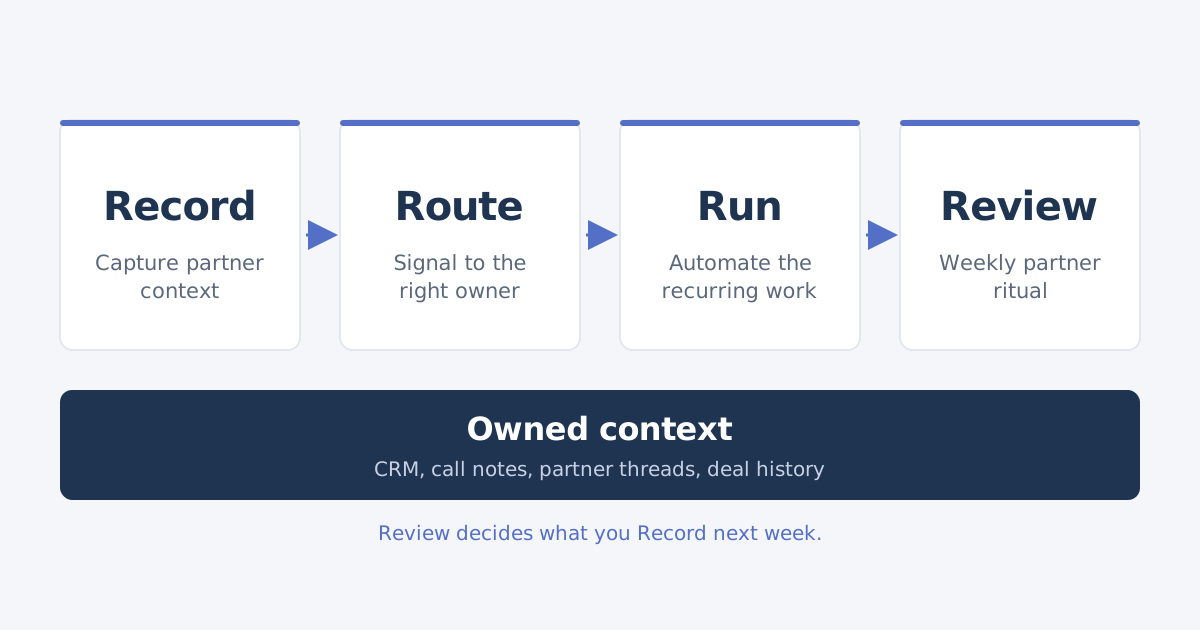
Most partner teams don't have a tool problem. They have a desk problem. Four layers, Record, Route, Run, Review, turn a pile of tools into one way of working.

Rob Moyer
Founder, BlueThread
Your partner team doesn't have a tool problem. It has a desk problem.
Most partner leaders I talk to are not short on software. They have a CRM, a PRM, Slack, a call recorder, a notes app, and at least one AI model. What they don't have is a desk: one place where the work actually gets done, in the same order, every week.
So the partner pipeline gets rebuilt by hand on Monday morning. Commitments from a partner call live in someone's head. A deal reg alert lands in a channel nobody watches. And the QBR deck gets built from scratch every quarter because last quarter's context never got written down.
At our Co-Sell Summit in San Francisco this September, the workshop sessions came at partner execution from very different angles. When I lined the notes up afterward, the same four jobs kept showing up. I call it the Operator Desk.
1. Record
Capture partner context where it compounds.
Every partner interaction produces signal: who's engaged, what they committed to, which accounts overlap, what the cloud rep said. Most of it evaporates within 48 hours.
The rule: if a partner commitment isn't written down within a day, it didn't happen. Call notes, deal touches, and asks go to one system of record, not five.
This is the layer that matters most. Models are rented. Anyone can buy the same one you use. Your partner context is the only part of the stack you own, and nobody can sell it to you.
2. Route
Get the signal to the right person or system, fast.
A signal nobody acts on is just noise. Deal registrations, partner asks, co-sell requests, cloud rep intros: each one needs an owner and a destination.
The rule: every signal type has a named owner and a defined next step. If you can't say where a deal reg alert goes and who touches it first, you have a routing gap, and partners feel it before you do.
3. Run
Take the recurring work off the human.
Partner work has a rhythm. Call recaps. The weekly pipeline sweep. QBR prep. Co-sell asks to the field. Partner-sourced pipeline updates that nobody does unless someone chases them.
The rule: pick the three to five recurring jobs that eat the most hours and automate those first. Not everything. The ones that repeat every week and look the same every time.
4. Review
Close the loop on a fixed cadence.
Without a review, the other three layers drift. Records get stale, routes break quietly, and automations run on bad inputs.
The rule: one weekly partner review, same day, same questions. For example:
- Which partner-influenced deals moved, and which stalled?
- What did we commit to partners last week, and did we deliver?
- Which signals came in with no owner?
- What's one thing we should stop doing?
What comes out of Review decides what you Record next week. That's the loop.
Why it's tool-agnostic
The Desk is a way of working, not a product. It runs on HubSpot or Salesforce, Slack or Teams, Claude or ChatGPT. Swap the model and nothing breaks. Lose the context and you start over.
That's the point. Tools change every quarter. A partner team that knows how it records, routes, runs, and reviews can absorb any new tool in a week. A team that doesn't will buy another one and wonder why nothing changed.
Where to start
Take one week and map your current setup against the four layers. For each one, write down where it lives today and who owns it. Most teams find one layer is strong, two are improvised, and one doesn't exist at all.
Fix the weakest layer first. In my experience it's usually Record, because everything downstream depends on it.
Subscribe to the newsletter
Get the Weekly Partnership Brief
The Partnership Brief is a weekly highlight of partnership, co-sell, and hyperscaler news, written for operators.
Rate this article
Comments
No comments yet. Be the first to share your thoughts.
Sign in to join the conversation
Sign In