The economics moved before the task list did. That sentence has opened this series from the first episode, and thirteen weeks of evidence have filled it in. Vendors moved money toward attested outcomes, marketplace transactions, and partner-built IP while most partner teams were still counting the hours AI saved them. Agents started sourcing deals, reading listings, and running workflows before anyone wrote down how to credit them or who answers when they get something wrong. The task list changed in plain sight. The revenue logic underneath it changed quietly, one program update at a time.
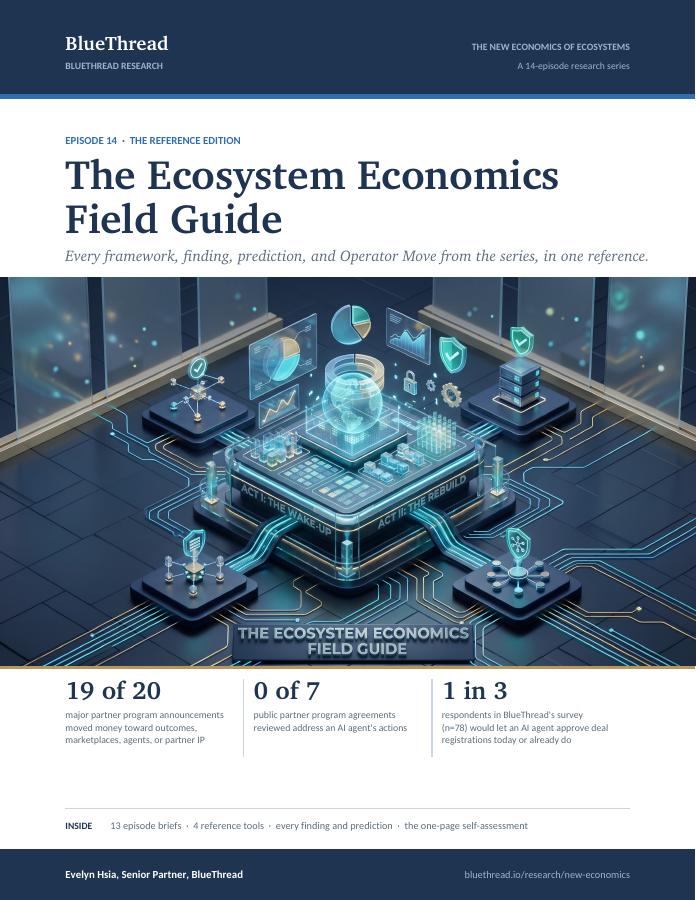
This Field Guide is Episode 14 of the series, and it holds the whole series in one place: every framework, named graphic, research finding, prediction, and Operator Move from Episodes 1 through 13, condensed to one tight section each, followed by the four reference tools the series built: the four revenue types, the Outcome Ledger, the Ecosystem Economics Maturity Model, and the path from Level 1 to Level 4. Read it start to finish if you are new. Jump to your binding constraint if you have already scored your team.
Act I · The Wake-Up
1. Partnership Leaders Are Solving the Wrong AI Problem
The argument. Partner teams treat AI as a task problem: automate the tedious work, bank the hours. The bigger change is underneath, in the revenue logic those tasks carried, and automating a task leaves the number attached to it unowned.
The graphic. The Two Questions.
The stat. BlueThread coded 20 major partner program announcements from the past 12 months; 19 of the 20 moved money, credit, or deal flow toward attested outcomes, marketplace transactions, agent-mediated sourcing, or co-developed IP.
The Operator Move. Sort your team's ten most time-consuming tasks into automate, augment, and defend, then write down the revenue logic attached to every task you automate. Download the task audit template. Read Episode 1.
2. The $750M Signal: How to Read the Hyperscaler Playbook
The argument. Google's $750 million partner fund and AWS's outcome funding read as incentive news. Read through their mechanics, they describe a build economy and a new definition of a partner deal.
The graphic. The Decoder.
The stat. Of the 20 announcements in the audit, six moved money toward attested or deployment outcomes, five toward marketplace-verified transactions, four toward co-developed IP, three toward agent-mediated sourcing, and one reset program economics (Anthropic's open, free partner network). One reinforced traditional deal registration.
The Operator Move. Ask each strategic vendor's partner development manager three questions: what share of incentives requires an attested outcome, how off-marketplace sourcing will be counted, and what funding exists for partner IP. Ask again in two quarters. Read Episode 2.
3. From Reseller to Co-Developer: The Ecosystem Value Chain
The argument. The old chain of source, sell, implement, and support is being compressed. Margin is moving to three new links: co-developing IP, orchestrating outcomes, and governing agents.
The graphic. The Ecosystem Value Chain.
The stat. Canalys, now part of Omdia, sizes the 2026 global IT market at $6.07 trillion, with partners touching 96 percent of it in some form: the market in which partner economics are changing.
The Operator Move. Bring one page to your next partner QBR: where your margin comes from today, which new link each source maps to, and what you are building this year that earns margin in 2028. Read Episode 3.
4. Your Partner Program Was Built Before AI
The argument. A classic partner program has about ten load-bearing components, and each encodes an assumption from before AI. The components built on proxies (headcount, badges, registrations) are breaking; the ones built on judgment hold.
The graphic. The Program Stress Map.
The stat. Six of the 20 announcements in the audit moved incentive dollars from activity to attested or deployment outcomes.
The Operator Move. Score ten program components 2 (holds), 1 (strained), or 0 (built on a dissolved assumption), starting with whether your tiers distinguish partners by outcomes or by size and badge count. Read Episode 4.
Act II · The Rebuild
5. The New Partner Career
The argument. The market is repricing partner skills in real time. Administrative work is disappearing from senior roles, co-sell and revenue accountability are now the baseline, and program, ecosystem, and AI fluency command the premium.
The graphic. Skills 2x2 (Disappearing, Commodity, Premium, Emerging).
The stat. In 121 coded partner manager job descriptions, 12 percent screened for AI fluency as a candidate skill: 65 percent at AI-native firms against 6 percent at enterprise platforms. Across a separate, broader pipeline of 1,000 open partnership postings, 21 percent carried some AI signal.
The Operator Move. Sort your own responsibilities into the four quadrants and see where most of your week actually goes. Read Episode 5.
6. Enablement When the Learner Is an Agent
The argument. Partner enablement now has two audiences: the person and the partner's AI stack. Content only a person can read becomes a bottleneck in the same revenue logic the rest of the series traces.
The graphic. The Two-Audience Enablement Stack.
The stat. BlueThread audited 19 major partner programs for machine-readable enablement. One met the bar for agent-callable enablement: AWS Partner Central's MCP server, with eight agent-callable operations including funding eligibility.
The Operator Move. Score your five most-used enablement assets 0 to 4 for machine-readability. Anything under 8 in total is your starting backlog. Read Episode 6.
7. Co-Sell When Agents Source the Deal
The argument. Crediting deals among several people was unsettled long before agents arrived. An agent that sources a deal adds a new claimant, the person who built and runs it, and almost no comp plan has a rule for that person.
The graphic. The Three-Way Split.
The stat. An Alexander Group survey, cited by WorldatWork, found 58 percent of companies credit two or more sellers on the same sale. PartnerStack and Wynter found partner revenue attributed 42 percent multi-touch, 31 percent first-touch, and 19 percent last-touch across 100 B2B SaaS leaders.
The Operator Move. Put your comp plan beside your PRM crediting rules and check whether either one recognizes an agent as a source of a deal. Read Episode 7.
8. The Marketplace Becomes the Deal Registration
The argument. When a marketplace transaction is the deal, the transaction record establishes the purchase and its commercial participants, which answers much of what deal registration used to answer; origination and influence can still need separate evidence. The listing a buying agent can read is the listing that gets compared.
The graphic. The Agentic Buying Journey.
The stat. BlueThread read six major marketplaces the way a buying agent would. One, AWS Marketplace, met the bar for agent transactions, letting an agent search the catalog, read public and private-offer terms, and drive a private-offer negotiation through APIs.
The Operator Move. Score your own top listing through an agent's eyes: price, private-offer terms, differentiation signals, and whether you would know if a competitor's listing were more readable. Read Episode 8.
9. Rebuilding the Partner Ops Stack
The argument. A complete partner ops stack has four layers: PRM, connector, orchestration, and outcome. Vendors cover the first three in different ways. None of the vendors we reviewed covered the outcome layer as of September 2026. The plumbing is solvable. The money is not.
The graphic. The Partnership Operating Stack.
The stat. In BlueThread's State of Partnerships survey, 53 percent of the 78 respondents named their own spreadsheets and manual processes as the one thing they would rip out, more than named any purchased tool, and 21 percent said the stack is already right.
The Operator Move. Check whether each of the four layers has a named tool in active use, and which system you would trust as the tiebreaker when two of them disagree. Read Episode 9.
Act III · The Money
10. Who Gets Paid? The Multi-Party Attribution Problem
The argument. Outcome-based funding can now verify that an outcome happened. It cannot say whose outcome it was when several partners touched it. Deals now get made four ways, and the attribution tools we reviewed natively record two of them.
The graphic. The Four Revenue Types.
The stat. On the hardest of four Trust Frontier questions in BlueThread's survey, approving deal registrations, exactly half of the 78 respondents answered "not without human review," the most common answer on three of the four questions.
The Operator Move. Run one multi-party deal from last quarter through the four types and see whether you could defend its credit split to your CFO in one sentence per party. Read Episode 10.
11. Who's Accountable When the Outcome Doesn't Land?
The argument. Multi-party deliveries are governed by contracts written for two parties and no agents. When the outcome misses, liability tends to land on whichever partner signed with the customer, regardless of whose component caused the miss.
The graphic. The Accountability Gap.
The stat. BlueThread reviewed seven public partner program agreements. None of the seven addresses an AI agent's actions or allocates responsibility across more than two parties. Negotiated agreements and customer delivery contracts were outside the review.
The Operator Move. Check your next multi-party deal's paper for five clauses: agent actions are attributable, a responsibility schedule names every party, logs are retained, missed milestones have a pre-agreed allocation, and approval thresholds and a suspension right are written down. Read Episode 11.
12. The Outcome Ledger
The argument. The missing piece behind both credit and accountability is a shared record: contribution events logged per party, human or agent, weighted by role, and settled against attested outcomes.
The graphic. The Outcome Ledger.
The stat. Illustration on assumed commercial terms (a $200,000 deal, a 20 percent partner pool, a 40/30/30 release schedule). Registration logic pays one partner $40,000 at signature. The ledger pays four partners $28,000 over 180 days; the $12,000 difference comes from the missed 180-day outcome tranche, not from the allocation itself.
The Operator Move. Run one closed deal from last quarter through the ledger in a spreadsheet and compare the result to what you actually paid. Read Episode 12.
13. The Ecosystem Economics Operating Model
The argument. The partner organization of 2028 runs on ecosystem architecture and agent governance, tiers its programs on outcomes, and settles multi-party economics on a ledger. Thirteen checks measure how far any team is from it.
The graphic. The Ecosystem Economics Maturity Model.
The stat. One in three respondents in BlueThread's survey (33 percent of 78) already let an AI agent approve deal registrations or would today; 9 percent already do.
The Operator Move. Score your org on all thirteen checks with the free maturity scoring sheet, find your binding constraint, and share your level. Read Episode 13.
Every BlueThread Research finding, indexed
| Episode | Finding | Dataset |
|---|---|---|
| 1, 2, 4 | 19 of 20 major partner program announcements moved money, credit, or deal flow toward attested outcomes, marketplace transactions, agent-mediated sourcing, or co-developed IP | The Announcement Audit |
| 5 | 12% of 121 partner manager job descriptions screen for AI fluency (65% AI-native, 6% enterprise platforms) | Job description coding, April 2026 |
| 5 | 21% of 1,000 open partnership postings carry an AI signal | BCIP active pipeline (separate, broader dataset) |
| 6 | 1 of 19 major partner programs reviewed publishes enablement an agent can call (AWS Partner Central) | Enablement machine-readability audit |
| 8 | 1 of 6 major marketplaces reviewed lets a buying agent read terms and transact through APIs (AWS Marketplace) | Marketplace agent-readability read |
| 9 | 53% of respondents would rip out their own spreadsheets and manual processes; 21% say the stack is right | State of Partnerships survey, n=78 |
| 10 | Half of respondents would let an agent approve deal registrations only with human review | State of Partnerships survey, n=78 |
| 11 | 0 of 7 public partner program agreements reviewed address AI agent actions or allocate responsibility across more than two parties | Partner agreement review |
| 12 (illustration) | Registration logic: $40,000 to one partner. Ledger: $28,000 to four, $12,000 unearned on the missed outcome tranche | Illustration on assumed commercial terms; not an empirical finding |
| 13 | Trust Frontier Index spread: 16, 16, 18, 18, and 10 respondents at scores 0 to 4; median 2 | State of Partnerships survey, n=78 |
Third-party figures cited in the series, including Canalys, the Alexander Group, PartnerStack and Wynter, TSIA, and SaaStr, are credited to those sources in each episode.
Every prediction, logged
| Episode | Prediction | Deadline |
|---|---|---|
| 1 | Outcome-attested funding is standard in every major hyperscaler program, and self-reported co-sell earns no incentive dollars at any of them | End of 2028 |
| 2 | Every major hyperscaler runs a formal partner IP co-development fund | 18 months from Episode 2 |
| 3 | "AI deployment firm" is a recognized partner category in at least three major vendor programs | End of 2027 |
| 4 | A top-five vendor program removes headcount and certification counts from tier qualification | End of 2028 |
| 5 | A majority of enterprise-platform partner manager postings screen for AI fluency | October 2027 |
| 6 | A top-five vendor program publishes an agent-callable interface for core enablement content, generally available | End of 2027 |
| 7 | A major PRM or comp platform ships partial credit for a documented AI-agent sourcing event | End of 2027 |
| 8 | A major cloud marketplace lets a buyer's agent discover, read private-offer terms, and transact end to end | End of 2027 |
| 9 | A cross-layer acquisition collapses a typical four-vendor partner stack to two or fewer | End of 2027 |
| 10 | A major CRM or PRM ships a native field for embedded or orchestrated revenue | End of 2027 |
| 11 | AWS, Microsoft, or Google Cloud publishes partner terms allocating responsibility for AI agent actions | End of 2027 |
| 12 | A major program or PRM pays several partners from one deal's pool on logged contributions, partly after a confirmed outcome | End of 2027 |
| 13 | A top-five vendor program makes AI-agent approval the default path for deal registrations | End of 2028 |
Each one is logged to the public scorecard, with the full wording in its episode.
The four revenue types
Sourced. A partner originated the opportunity before anyone else touched it. Tracked by today's attribution tools.
Influenced. A partner helped move the deal without originating it. Tracked by today's attribution tools.
Embedded. A partner's product or capability is built into what the customer actually receives. No vendor data model we found has a field for it.
Orchestrated. A partner's system runs the workflow that produces the outcome, coordinating other parties' contributions. No vendor data model we found has a field for it.
The Outcome Ledger, on one page
Rule 1, log. Every contribution is an event: which party, whether a person or an agent did the work, which of the four types, and the evidence. An agent's work is booked to the party that operates it.
Rule 2, weight and grade. Each party scores once per type, at its best evidence. Proposed default role weights: sourced 35, embedded 30, orchestrated 20, influenced 15. Evidence grades: system-verified 1.0, counterparty-confirmed 0.6, self-reported 0.
Rule 3, settle. The ledger divides the partner pool the vendor already budgets, released in tranches as the customer attests outcomes. A missed tranche stays unearned, and the ledger records why.
The threshold. Run it on deals above a set value or with more than two parties. Below that line, the old sourced-or-influenced call is fine. The weights and grades are proposed defaults, not empirically validated measures of contribution, and every default is published to be argued with.
The Ecosystem Economics Maturity Model
Score each of the thirteen checks from 1 to 4. Average them within each act, then overall. The overall average places you at Experimenting (1.00 to 1.74), Adjusting (1.75 to 2.49), Instrumenting (2.50 to 3.24), or Redesigning (3.25 to 4.00). Your lowest act average is your binding constraint.
| Act | Checks |
|---|---|
| I. The Wake-Up | 1 The AI problem · 2 Reading vendor signals · 3 The value chain · 4 Program design |
| II. The Rebuild | 5 The partner career · 6 Enablement · 7 Co-sell credit · 8 Marketplace · 9 The ops stack |
| III. The Money | 10 Attribution · 11 Accountability · 12 The ledger · 13 The operating model |
Claim a level only if you can show the artifact that proves it. The full level descriptions and the Trust Frontier benchmark are in the free scoring sheet.
The path from Level 1 to Level 4
From Experimenting to Adjusting. Run the Episode 1 task audit and keep the list of revenue numbers your automation leaves unowned. Ask your vendors the three Episode 2 questions. Most teams can make this move in one quarter.
From Adjusting to Instrumenting. Run the Episode 4 stress test on your program, score your enablement and marketplace listing for machine-readability (Episodes 6 and 8), and give every layer of your ops stack a named tool and a tiebreaker (Episode 9). This is where the evidence starts to exist.
From Instrumenting to Redesigning. Apply the four revenue types to your highest-stakes deals (Episode 10), put the five accountability clauses into your multi-party paper (Episode 11), run qualifying deals through a ledger (Episode 12), and write down the delegation rules that make your Trust Frontier score something you can defend (Episode 13).
The Operator Move: the one-page self-assessment
The Field Guide download carries one page that combines the three diagnostics a team needs to start: the Episode 1 task audit, the Episode 4 program stress test, and the Episode 13 maturity score, with a box for your binding constraint and the one check you will move next quarter. It is the start-here worksheet for any team beginning the whole program, and the only gated download of the series.
Download the Field Guide as a PDF, with the self-assessment as its final page, from the form below. It asks for your name and email, and you can also choose to receive BlueThread Weekly: The Partnership Brief.
Download the Field Guide
Fill in your name and email to download the Field Guide as a PDF, with the one-page self-assessment as its final page. You can also choose to receive BlueThread Weekly: The Partnership Brief.